UAE E-Invoicing 2027: What Small Businesses and Freelancers Must Do (and When)
From July 2027 every UAE business under AED 50 million must send B2B invoices through an Accredited Service Provider. Here is the timeline, who is covered, the fines, and what you can keep doing with PDF invoices until then.
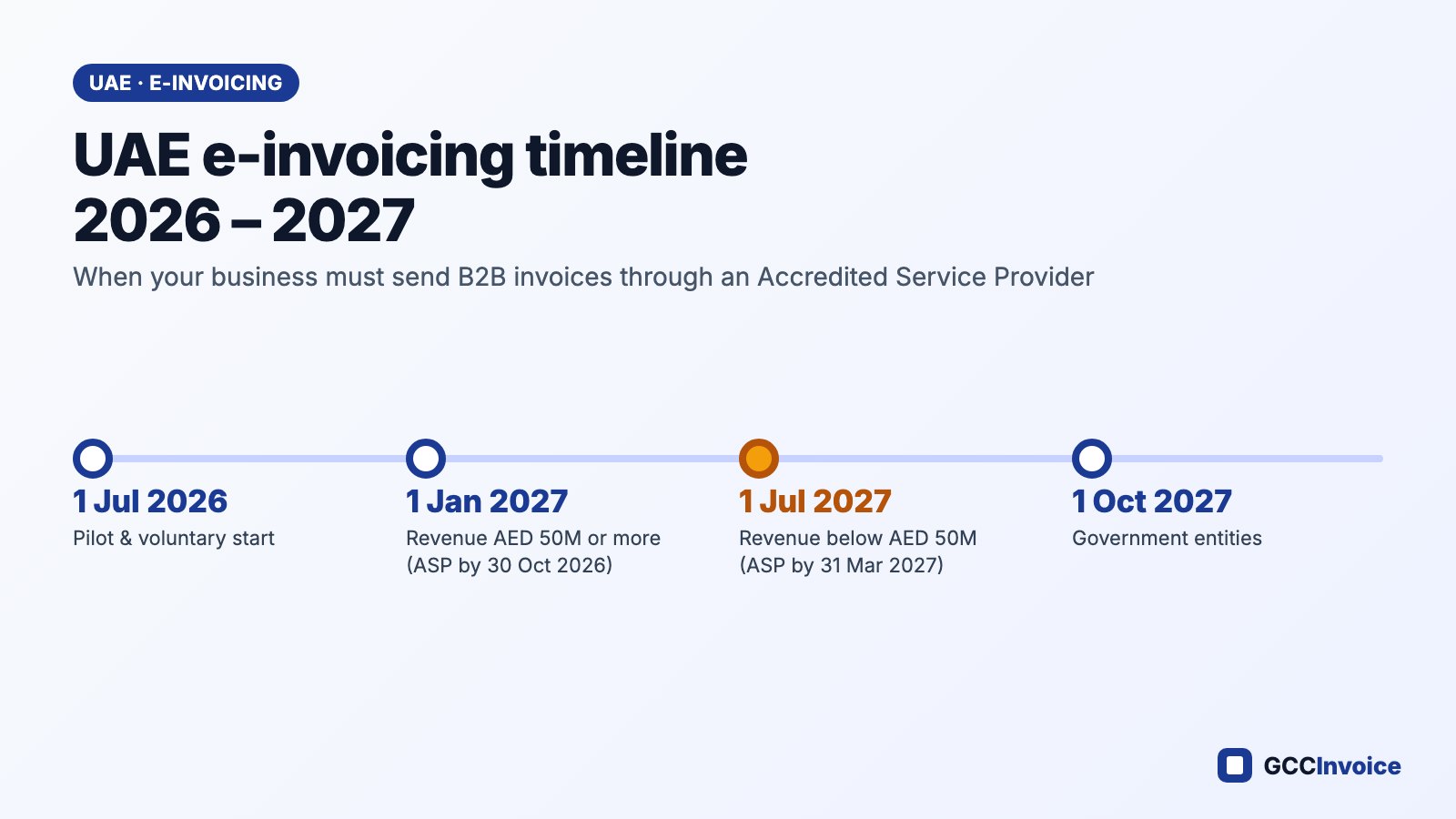
The UAE is replacing PDF and paper invoices between businesses with structured electronic invoices that travel through accredited providers and are reported to the Federal Tax Authority (FTA). If you run a small company, a trading licence or a freelance business in the UAE, your deadline is 1 July 2027, and you must choose a provider by 31 March 2027.
This guide explains, in plain language, what is changing, who is covered, what the fines are and what you can keep doing with PDF invoices in the meantime. It is based on Ministerial Decisions No. 243 and 244 of 2025 (as amended in May 2026) and Cabinet Decision No. 106 of 2025.
💡 Tip: you can make one in under two minutes with our free invoice generator: no sign-up, no watermark, PDF in English or Arabic.
What is UAE e-invoicing?
Today most UAE businesses create an invoice as a PDF, email it and keep a copy. Under the new system the legal invoice is a machine-readable data file (XML, in a UAE format called PINT-AE) instead. It is sent from your system to your customer's system through the Peppol network, and the tax data is reported to the FTA almost in real time.
You never connect to the FTA yourself. Every business appoints one Accredited Service Provider (ASP), a company approved by the Ministry of Finance, that sends, receives and reports your invoices.
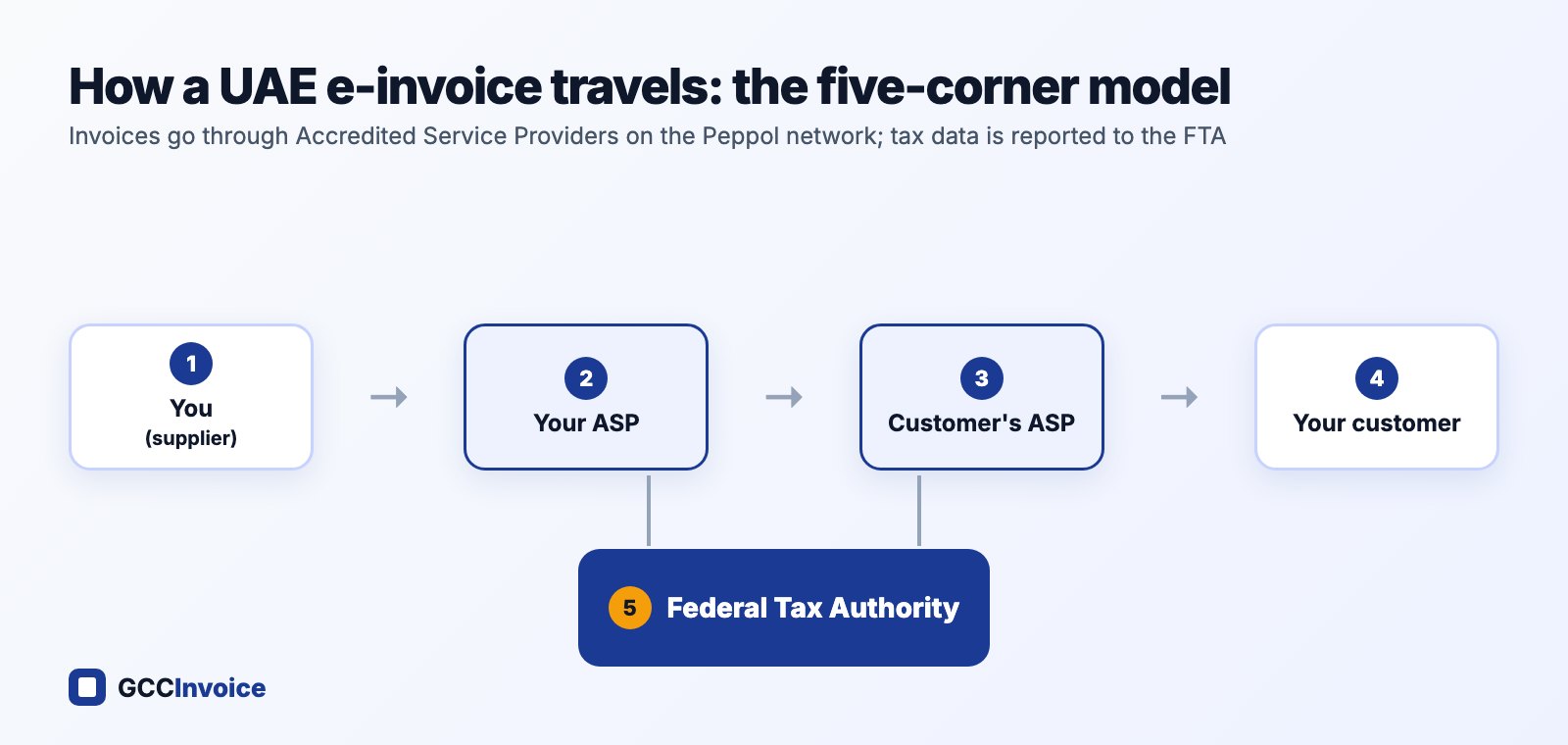
This is called the five-corner model: (1) you, (2) your ASP, (3) your customer's ASP, (4) your customer, and (5) the FTA, which receives the tax data from the ASPs.
The timeline: which date applies to you
The split is your annual revenue: AED 50 million or more, or less.
| Who | Appoint an ASP by | E-invoicing mandatory from |
|---|---|---|
| Voluntary / pilot participants | Any time | 1 July 2026 (optional) |
| Businesses with revenue of AED 50 million or more | 30 October 2026 (extended from 31 July 2026) | 1 January 2027 |
| Businesses with revenue below AED 50 million (most SMEs and freelancers) | 31 March 2027 | 1 July 2027 |
| Government entities | 31 March 2027 | 1 October 2027 |
In May 2026 the Ministry of Finance gave large businesses three more months to appoint an ASP, but it did not move any go-live date. Plan on the dates above.
Who has to use e-invoicing?
The rules apply to anyone doing business in the UAE: mainland companies, free zone companies, branches, sole establishments and freelancers. Importantly, this is not limited to VAT-registered businesses. If you sell to other businesses in the UAE, you are in scope even if your turnover is below the VAT registration threshold.
What is covered
- B2B: invoices you send to other businesses.
- B2G: invoices to government entities.
- Credit notes for those invoices.
What is excluded (for now)
- B2C: sales to individual consumers are excluded until a future ministerial decision. A shop, salon or restaurant selling to the public can keep issuing normal receipts and invoices.
- Government activities in a sovereign capacity.
- Exempt or zero-rated financial services.
- International passenger air transport (e-tickets), and temporarily some international air cargo (airway bills).
The fines
Cabinet Decision No. 106 of 2025 sets the administrative penalties. The main ones for a small business:
| Violation | Fine |
|---|---|
| Not implementing e-invoicing or not appointing an ASP on time | AED 5,000 for each month (or part of a month) of delay |
| Not issuing or sending an e-invoice or credit note on time | AED 100 per document, capped at AED 5,000 per month |
| Not reporting a system failure to the FTA, or not updating your data with your ASP | AED 1,000 per day |
Two practical deadlines in the rules: e-invoices and credit notes must be issued within 14 days, and a technical failure on your side must be reported to the FTA within 2 business days.
What small businesses and freelancers should do now
- Check your revenue band. Below AED 50 million? Your deadlines are 31 March 2027 (ASP) and 1 July 2027 (go-live).
- Split your sales into B2B and B2C. If almost all your customers are individuals, the immediate impact is small. If you invoice companies, you are in scope.
- Get your TRN and master data right. Your Peppol identifier is based on your TRN, and every e-invoice needs correct legal names, TRNs and addresses for you and your customers. Start collecting customer TRNs now.
- Shortlist ASPs. The Ministry of Finance publishes the list of accredited providers. Many accounting apps will offer e-invoicing through an ASP partner, so ask your current software provider first. Compare price per invoice, not just the subscription.
- Clean up your invoice numbering. Sequential, unique numbers and proper credit notes (instead of editing or deleting invoices) make the switch painless. See our guide to invoice numbering and credit notes.
- Budget for it. Treat the ASP fee as a normal running cost from mid-2027, like your trade licence renewal.
Can I still use PDF invoices?
Yes, for now and in many situations afterwards:
- Until your go-live date (1 July 2027 for most SMEs), a correct PDF tax invoice remains the normal way to invoice. Make sure it has everything the FTA requires; see our UAE tax invoice checklist.
- B2C sales stay outside e-invoicing until the Ministry decides otherwise.
- Quotations, proforma invoices and receipts are not tax invoices, so you can keep sending them as PDFs.
- After go-live, many businesses will still send a PDF copy for the customer's convenience. The legal invoice, however, is the structured e-invoice sent through your ASP.
Need an invoice today? Our UAE invoice generator creates a VAT-ready PDF with your TRN, 5% VAT and AED amounts in English or Arabic, free and without sign-up. To be clear: GCCInvoice is a free PDF invoicing tool, not an Accredited Service Provider. Use it for quotations, B2C sales and your invoices until your e-invoicing go-live.
How UAE e-invoicing compares with Saudi Arabia
Saudi Arabia has run e-invoicing (FATOORA) since December 2021, with ZATCA connecting businesses in waves. The UAE model is different: it is built on Peppol and a decentralised network of accredited providers, rather than each business integrating directly with the tax authority. Oman is following the same Peppol route with its Fawtara programme. If you trade in both countries, read our ZATCA e-invoicing guide as well.
Frequently asked questions
Does UAE e-invoicing apply if I am not VAT-registered?
Yes, if you issue B2B or B2G invoices. The scope covers persons conducting business in the UAE, not only VAT registrants.
I am a freelancer who invoices companies. When do I start?
With revenue below AED 50 million, appoint an ASP by 31 March 2027 and issue e-invoices from 1 July 2027.
Do I need e-invoicing for sales to consumers?
Not for now. B2C transactions are excluded until a future ministerial decision.
Can I build my own connection to the FTA?
No. Invoices are exchanged and reported through an accredited service provider, so every in-scope business needs one.
What happens if I miss the deadline?
The fine for not implementing the system or not appointing an ASP on time is AED 5,000 for every month of delay, plus per-invoice fines for e-invoices that are not issued.
This article is general information, not tax advice. Rules and dates can change; check the latest announcements from the UAE Ministry of Finance and the Federal Tax Authority, or ask your tax adviser. Last checked: October 2026.
Ready to create your invoice?
Use our free invoice generator: no sign-up, no watermark, ready in under two minutes.
Open the Free Invoice GeneratorKeep reading
Is There VAT in Kuwait? 2026 Tax Guide for Small Businesses
No. Kuwait still has no VAT in 2026, and the government has signalled it will not come before 2028. Here is what Kuwaiti businesses actually pay, how to invoice without VAT, and what to do when you sell to the UAE or Saudi Arabia.
09 Oct 2026 · 6 min read
Simplified Tax Invoice Saudi Arabia vs Standard Tax Invoice
When can you issue a simplified tax invoice in Saudi Arabia, and when do you need a full tax invoice? Compare required fields side by side, see a worked 15% VAT example, and learn the deadlines, QR code and Arabic rules from ZATCA's latest guideline.
30 Sep 2026 · 9 min read
GCC VAT Rates 2026: A Country-by-Country Guide
Saudi Arabia 15%, Bahrain 10%, UAE and Oman 5%, and still no VAT in Kuwait or Qatar. Compare GCC VAT rates, registration thresholds, tax number formats and currency decimals in one clear table, and learn what each means for your invoices.
30 Sep 2026 · 9 min read