Is There VAT in Kuwait? 2026 Tax Guide for Small Businesses
No. Kuwait still has no VAT in 2026, and the government has signalled it will not come before 2028. Here is what Kuwaiti businesses actually pay, how to invoice without VAT, and what to do when you sell to the UAE or Saudi Arabia.
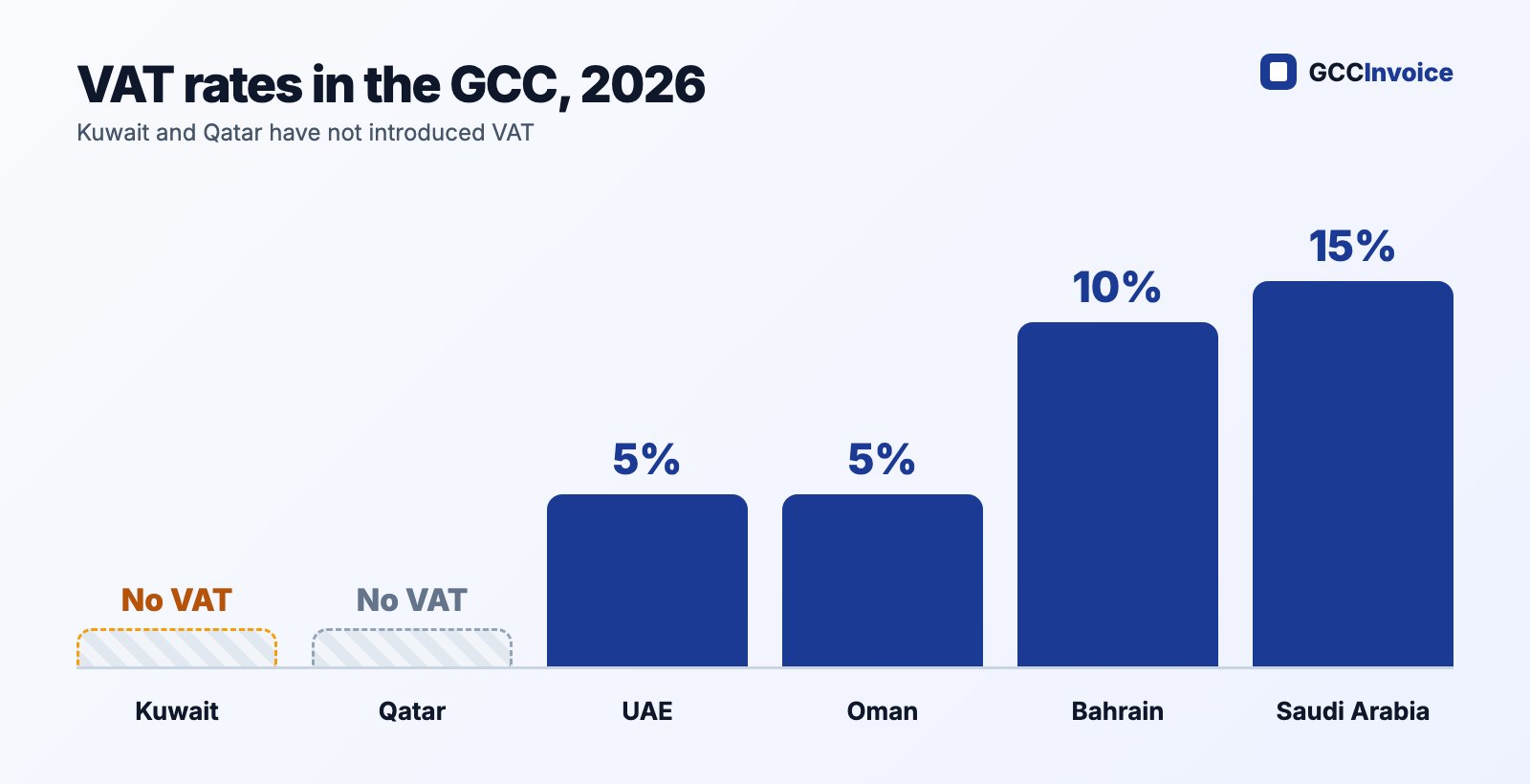
Short answer: no. As of 2026 there is no value added tax (VAT) in Kuwait. You do not charge VAT on your invoices, you do not register for VAT and you do not file VAT returns. Kuwait and Qatar are the only two GCC countries that have not introduced VAT.
But "no VAT" does not mean "no tax rules", and if you sell to customers in the UAE, Saudi Arabia, Bahrain or Oman, their VAT can still affect your invoices. This guide covers what Kuwaiti businesses actually pay in 2026, how to invoice correctly without VAT, and what to watch for next.
💡 Tip: you can make one in under two minutes with our free invoice generator: no sign-up, no watermark, PDF in English or Arabic.
Why Kuwait still has no VAT
In 2016–2017 all six GCC states signed the Unified VAT Agreement, which set a common 5% starting rate. Saudi Arabia and the UAE introduced VAT in January 2018, Bahrain in 2019 and Oman in April 2021. Kuwait drafted a VAT law but it was never passed by the National Assembly, where new taxes on consumers have faced strong opposition for years.
Instead, the government's reform plans have focused on taxing large companies and on possible excise taxes on specific goods (such as tobacco and sugary drinks) rather than a broad VAT. Reports on the government's current four-year programme indicate that VAT is not expected before 2028, and any VAT would need a new law, an implementation period and registration rules before businesses are affected. In other words: if VAT ever comes to Kuwait, you will have plenty of notice.
Which taxes do Kuwaiti businesses pay in 2026?
| Tax | Who pays | Rate |
|---|---|---|
| VAT | Nobody (not introduced) | None |
| Corporate income tax | Foreign companies doing business in Kuwait (on the foreign share of profits). Companies wholly owned by Kuwaiti or GCC nationals are exempt. | 15% |
| Domestic Minimum Top-up Tax (DMTT) | Large multinational groups with global revenue of EUR 750 million or more, from 1 January 2025 (Decree-Law No. 157 of 2024) | Tops up to a 15% effective rate |
| Zakat | Kuwaiti public and closed shareholding companies | 1% of net profit |
| KFAS contribution | Kuwaiti shareholding companies | 1% of net profit |
| National Labour Support Tax (NLST) | Kuwaiti companies listed on the stock exchange | 2.5% of net profit |
| Customs duty | Importers (GCC common tariff) | Generally 5% of CIF value |
| Personal income tax | Nobody | None |
For a typical Kuwaiti-owned small business or sole trader (a shop, contractor, freelancer or online seller), this means no VAT, no income tax and no corporate tax. Your main obligations are your commercial licence, social security for Kuwaiti employees, customs duty on imports and keeping proper records.
How to write an invoice in Kuwait without VAT
Because there is no VAT, a Kuwaiti invoice is simpler than a GCC tax invoice. A good invoice still needs:
- The word "Invoice" (or فاتورة), and a unique, sequential invoice number.
- The invoice date and a due date.
- Your business name, address, phone and commercial registration (CR) number if you have one.
- Your customer's name (and company, if any).
- Each item with quantity, unit price and line total.
- Subtotal, any discount and the total in Kuwaiti dinars with three decimals, for example 125.750 KWD. The dinar has 1,000 fils, so two decimals are wrong. See our guide to currency decimals on GCC invoices.
- Payment terms and how to pay (bank transfer, KNET, cash).
What not to put on a Kuwaiti invoice
- Do not add a "VAT 0%" or "VAT 5%" line. There is no VAT in Kuwait, so a VAT line confuses customers and accountants.
- Do not call it a "Tax Invoice". That title has a legal meaning in VAT countries. A plain "Invoice" is correct.
- Do not invent a "TRN". Kuwait has no VAT registration number; use your CR number instead.
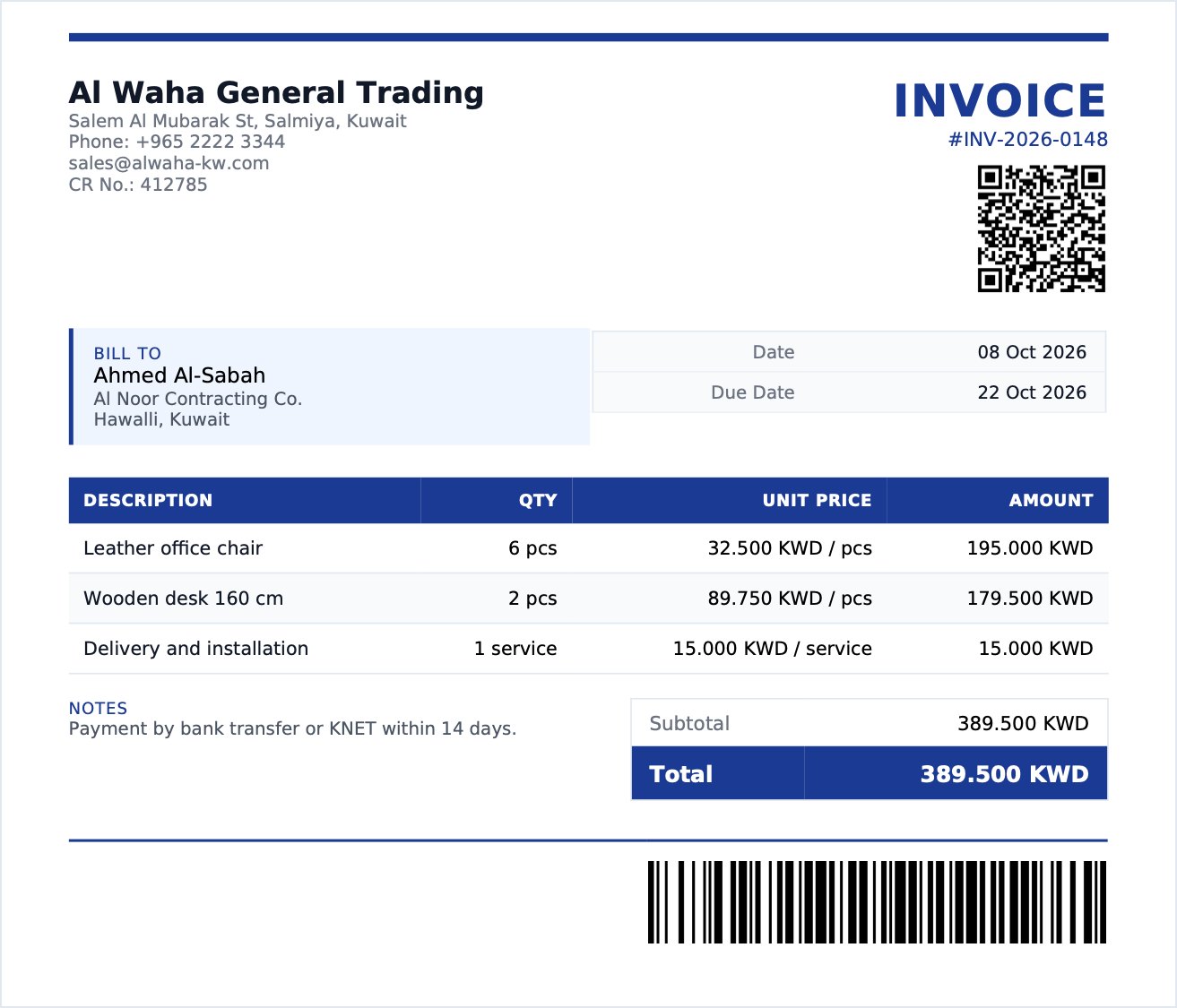
You can make an invoice exactly like this in two minutes with our Kuwait invoice generator. It uses KWD with three decimals by default and leaves VAT switched off. For a step-by-step walkthrough, read how to make an invoice in Kuwait.
Selling from Kuwait to customers in VAT countries
Kuwait has no VAT, but your customers in Saudi Arabia, the UAE, Bahrain or Oman live under VAT rules. A few practical points:
- You do not charge their VAT. A business with no VAT registration in that country cannot add VAT to its invoice. Invoice in your normal way, without VAT.
- Services to VAT-registered businesses: in Saudi Arabia and the UAE, a registered business that buys services from abroad usually accounts for the VAT itself under the reverse charge. Your customer may ask for your full legal name, address and a clear description of the service. That is why.
- Goods: import VAT and customs are normally paid at the border by the importer. Agree who the importer is (and the Incoterm) in your quotation.
- Currency: invoice in the currency you agreed, such as SAR, AED or USD, and show the KWD amount only if your customer asks for it.
- Selling directly to consumers in a VAT country at scale, or having a branch there, can create a VAT registration obligation in that country. Take local advice before you open a branch or warehouse there.
What could change, and how to be ready
Kuwait has been discussing wider tax reform, including excise taxes and broader taxes on business profits. None of this changes how a Kuwaiti small business invoices today. Still, a few habits will make any future change easy:
- Use sequential invoice numbers and keep every invoice (at least 5 years is a sensible minimum, longer if your auditor asks).
- Keep your CR number and business details correct on every invoice.
- Record sales per invoice, not just as daily totals.
- Use invoicing software that can switch VAT on with one click. Inside the GCC, many Kuwaiti suppliers already do this for invoices to UAE and Saudi customers.
Frequently asked questions
Is there VAT in Kuwait in 2026?
No. Kuwait has not introduced VAT. Prices and invoices do not include VAT.
When will Kuwait introduce VAT?
There is no confirmed date. The VAT law has never been passed, and current government plans reportedly rule out VAT before 2028.
Do I need a tax number on my Kuwaiti invoice?
There is no VAT number in Kuwait. Show your commercial registration (CR) number instead, if your business has one.
Does Kuwait have income tax?
There is no personal income tax. Corporate income tax of 15% applies to foreign companies doing business in Kuwait. Companies wholly owned by Kuwaiti or GCC nationals are exempt, although shareholding companies pay Zakat and the KFAS contribution.
How many decimals does the Kuwaiti dinar have on an invoice?
Three. 1 KWD = 1,000 fils, so write amounts like 15.500 KWD.
This article is general information, not tax advice. Sources include PwC Worldwide Tax Summaries (Kuwait, reviewed July 2026) and Kuwait's Decree-Law No. 157 of 2024. Check with a Kuwaiti tax adviser for your situation. Last checked: October 2026.
Ready to create your invoice?
Use our free invoice generator: no sign-up, no watermark, ready in under two minutes.
Open the Free Invoice GeneratorKeep reading
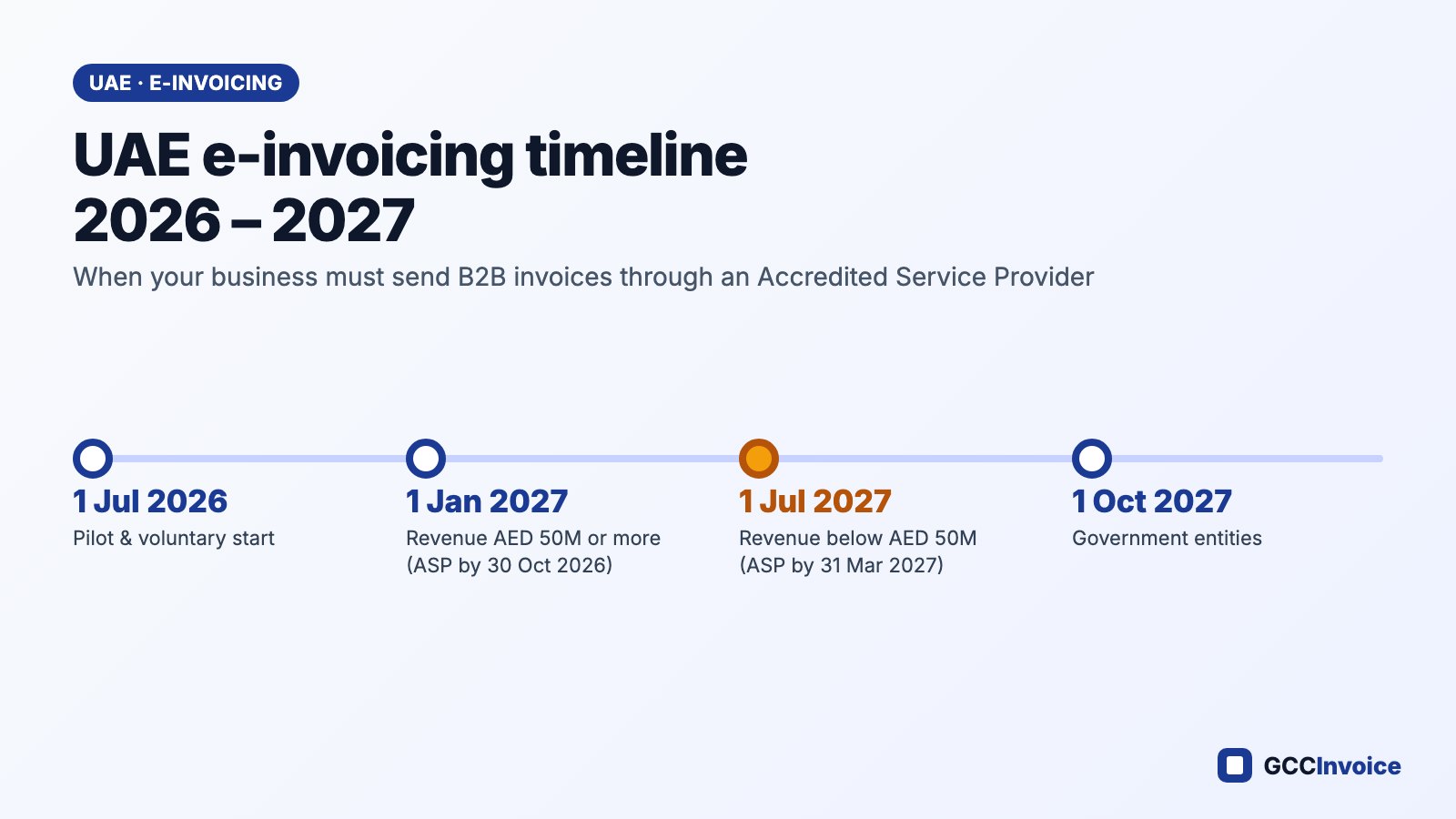
UAE E-Invoicing 2027: What Small Businesses and Freelancers Must Do (and When)
From July 2027 every UAE business under AED 50 million must send B2B invoices through an Accredited Service Provider. Here is the timeline, who is covered, the fines, and what you can keep doing with PDF invoices until then.
09 Oct 2026 · 6 min read
Simplified Tax Invoice Saudi Arabia vs Standard Tax Invoice
When can you issue a simplified tax invoice in Saudi Arabia, and when do you need a full tax invoice? Compare required fields side by side, see a worked 15% VAT example, and learn the deadlines, QR code and Arabic rules from ZATCA's latest guideline.
30 Sep 2026 · 9 min read
GCC VAT Rates 2026: A Country-by-Country Guide
Saudi Arabia 15%, Bahrain 10%, UAE and Oman 5%, and still no VAT in Kuwait or Qatar. Compare GCC VAT rates, registration thresholds, tax number formats and currency decimals in one clear table, and learn what each means for your invoices.
30 Sep 2026 · 9 min read